After working with the Harimau makan Elsa story for 3 weeks with multiple classes, I was getting a bit bored.
Harimau lapar. Harimau lihat Elsa. Harimau mau makan Elsa. Elsa lari ke pohon. Harimau lari ke pohon. Elsa lari ke rumah. Harimau lari ke rumah. Harimau makan Elsa.
I had laminated pictures of Elsa, tiger, tree and house with magnets on the back that I used to tell the story. (This can be seen in an earlier blog)
I decided to be a bit silly, so I retold the story, but switched the characters, so Elsa was hungry and wanted to eat the tiger. The tiger ran away and was finally eaten by Elsa. I was blown away by the response of the kids, they loved it! They thought it was hilarious. Amazing how one small change can re-engage everyone and produce giggles.
I also told them about never-ending songs, and how they can be used effectively to drive teachers, parents and bus drivers mad. We sang a little song invented by Bu Cathy which is sung to the tune ‘Found a Peanut’. Once again I used the ‘puppets’, and had Elsa running to first the tree, then the house, over and over again.
Elsa lari, Elsa lari, Elsa lari ke pohon
Ke pohon, Elsa lari, Elsa lari ke pohon
(Then repeat with rumah)
Once my voice was fading and some kids were putting hands over ears (after MANY reps), I had Elsa run to tiger and be eaten!
I encouraged students to go home and drive their family crazy with our song. It was wonderful the following week to be told by so many students that they drove someone crazy with our ditty!
For the last three weeks I have been working on the harimau story (adapted from Carol Gaab’s wolf story) with my Prep to Year 2 students. They have loved listening to me tell the story a couple of times with cardboard puppets attached to the whiteboard, then acting out the story in the classroom with actors. The fact that we have a life-sized banana tree in my room makes it even better!
I was worried they might become a bit bored by this routine, so this week (third week of the story) I asked Bu Cathy’s advice about how to get reps with variety. Use Catharina Greenberg’s Duplo activity, she advised. Now, I must admit I had read about this activity but had avoided it like the plague because quite frankly 25 young children getting a piece of Duplo at the same time sounds like utter chaos!
But I had a go anyway. One of my colleagues had a massive tub of coloured blocks which I was very happy to borrow. My first two classes were the Preps. I had my sentences (true and false) typed up ready to go. After the first two hours of lessons, I had four pieces of Duplo broken and I removed all delicate pieces from the tub!
So, after creating additional rules, the rest of the day went very smoothly. If you are thinking of trying this activity, I hope these rules are useful to you! The kids loved it and all listened carefully. I made them stockpile the Duplo and build at the end but next time will let them build as they go.
Duplo Rules
Take only one piece each time.
Place it behind your back and forget about it until the end of the story.
No knees, feet or hands leaning on Duplo.
Take a piece of Duplo using only one hand.
Crawl to the Duplo pile, and crawl backwards to your spot. (in their eagerness they would whip around to go back, sometimes kicking the Duplo)
Sit back in your spot on your bottom once ready to listen.
When I had finished reading the story, they had time to build (by themselves, or joining with others) and share their beautiful creations!
I like the idea of kids building as they go, but I can see them destroying their creations as they rush for a new piece. I would love to know exactly how Catherina manages this!
Whilst observing Bu Cathy’s class, I was impressed by Kursi Luar Biasa. Bu Cathy did it in the last part of the lesson and it went very smoothly. I tried in in my class when I got back, but unfortunately I did not leave enough time at the end of the lesson so we ended up not covering many questions. The questions I asked were too difficult for the students and I felt they needed more support. I knew I had seen a fantastic powerpoint somewhere on line, so I found it, adapted it and now present to you my own version of the powerpoint to accompany Murid Luar Biasa. I also purchased a gorgeous old wooden chair over the weekend for $25 and plan to scrub it back then paint it very colourfully as a holiday project. I will post the before and after photos on this blog! I am hoping it will go to plan and that it will be a Kursi Luar Biasa!
I think with the help of this powerpoint to focus the students’ attention and also to give support to those being questioned I can run Murid Luar Biasa as low as Kelas 1. That’s the plan!
It is that time of year again! When I started using TPRS I found it difficult to write appropriate report comments for my classes. I used as a rough guide some explanations about TPRS in the back of the Big CI Book. This year I have refined my comments further. I include them here in case they help anyone else who is struggling. Feel free to use and adapt for your situation:
Report Comments Semester 1 2016
Prep – 2
This semester {preferredName} has been exposed to comprehensible Indonesian input through the use of mini-stories, songs, games and TPR (Total Physical Response). {HeShe} has demonstrated a ___ level of understanding by responding orally (answering ‘ya’ – yes or ‘tidak’ – no) or physically (by using the correct gesture or by drawing). The focus this semester has been on acquiring ‘super verbs’ such as ‘mau’ (want), ‘punya’ (has), ‘pergi’ (go), ‘ada’ (there is), ‘beri’ (give) and ‘suka’ (like). At this level the main focus is on listening and showing understanding. You can support {preferredName}’s learning of Indonesian at home by encouraging retelling of the stories and songs we have learned in class.
Year 3
This semester {preferredName} has been exposed to comprehensible Indonesian input through the use of mini-stories, songs, games and TPR (Total Physical Response). {HeShe} has demonstrated a ___ level of comprehension by responding orally or physically (using the correct gesture/movement), translating, illustrating sentences and acting out stories. The focus this semester has been on acquiring ‘super verbs’ such as mau (want), punya (has), pergi (go), ada (there is), beri (give) and suka (like). At this level students are expected to use word lists and known words to rewrite modelled texts or create their own sentences and stories. {preferredName}’s written work shows a ___ level of understanding of Indonesian sentence structure and vocabulary. You can support {hisher} learning of Indonesian at home by encouraging {himher} to read and reread any stories we are working on in class. These will be available on Ibu Anne’s Indonesian page in DB Primary.
(Type in beginning, satisfactory or very good as needed.)
Recently I attended the Modern Language Teachers Association of Victoria’s annual conference. One of my colleagues there presented about the ‘flipped’ classroom. I thought it might be interesting to do some filming of stories for students to access at home, thus getting lots more reps. I made the following video to post on our school Facebook page and Twitter. I would love my Prep – Year 2 students to watch and listen so much that they can eventually retell the story themselves. Next time I will be filming students retelling stories!
Terima kasih to Bu Cathy for re-scheduling this meeting so that I could attend. It was so great to hear what other Indonesian TPRS teachers are doing. The meeting was held at Port Elliot Primary School.
Currently Hub members are using Spongebob may Sprite for junior learners and Bercakap-cakap terus for Years 3 – 6. I was amazed to hear that two of the teachers taught 6 new words per week to the middle students before beginning on the story. They appeared to remember the words really well!
I heard about some good activities for students:
order sentence strips
match sentence strips with pictures
order words
spelling battleships (instructions on Bu Cathy’s blog)
the Bop! game (also on Bu Cathy’s blog)
sing the story
Sing the story was great! To the tune of Baa Baa Black Sheep, students learn to sing the story, as in:
Lucy dingin.
Lucy mau jaket.
Peter panas.
Tidak mau jaket.
Peter kasi.
Lucy pakai jaket.
Lucy berkata, “Terima kasih, Peter”.
One of the teachers told us about a good game to practise ‘punya’ with young children. One person stands out the front of the group facing the whiteboard. Teacher quietly gives the ‘apel’ to someone in the group. The child at the front them turns around and has to discover who has the object by asking ‘Daniel punya apel? Lucy punya apel?’ etc.
Bu Cathy told us how teachers had used ‘Cicak Cicak di dinding’ and had students act it out.
I found out about three types of writing:
free write: students write about anything. This is a timed write from between 5 and 15 minutes
re-write: re-write the story students have learned in class
quick write: students write about a picture based on the story they have learned
The re-write can be made more interesting by taking out names of characters and places and asking students to make up their own, then illustrating.
More great ideas for junior classes:
charades in pairs, guess the verb
ask questions about the story, students pick up a piece of duplo if the answer is yes, don’t pick up if answer is no
listen and draw
wordle – use limited words for juniors. First to point to the word teacher says gets a point
guess the gesture
fruit salad – adapt with words from the story (can do with duck, duck, goose also)
quick draw – in pairs – one draws, the other states (in Indonesian) the line from the story
Raja Monyet – students sit on chairs in a circle, with one child Raja Monyet (king monkey) in centre. Teacher asks question (e.g. Kamu tinggal di mana?) Everyone answers with their own answer, but when Raja Monyet answers with ‘Saya tinggal di hutan’ (A special answer which teacher has previously told child), everyone must swap seats so that a new Raja Monyet (last one left standing) is found.
Guess the number (Saya pikir nomor) – even Preps can do this! Write numbers satu to lima (or more) on the board, like this:
1 satu
2 dua
3 tiga
4 empat
5 lima
Choose a student to come out and write their number on the back of the whiteboard where no other students can see. (Useful if you or the student forget the number!) then student picks others to guess the number. They put a cross next to the number if it is not correct. If it is correct, new child gets a turn. Must say the number in Bahasa Indonesia!
If playing the game with middle or upper students, tell them to think of a number between 1 – 40, or 1 – 100. Draw a horizontal line on the whiteboard. If the class group guess a number larger than the one the student is thinking of, then this number is written ABOVE the line. If it is smaller, the number is written BELOW the line. Students (hopefully) narrow down their options and guess quickly.
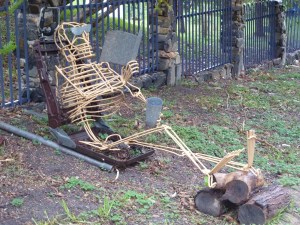
An ex-TPRS student who just couldn’t stop reading the new story! (On the way to Yankalilla)
Here are some good TPRS ideas I picked up from Bu Carmel:
use a music stand for your lesson plan (great idea – I always put mine down and lose it!)
go s-l-o-w-l-y, students understand so much better!
to settle students, Carmel says ‘satu, dua, tiga, diam’ twice. It works!
students fill out a self-assessment form after each lesson, based on how well they listened, responded etc
use a powerpoint presentation with aims of your lesson, stories, new words listed, pictures etc – Carmel’s powerpoint was ‘luar biasa’!
throw a ball and ask students a question, such as ‘Apa kabar?’ for quick answer practice.
use strip bingo (Martina Bex?) to revise words – I had not seen this used before. Students were asked to fold (lipat) a strip of paper in half, then in half again. They wrote any four words from the story. As teacher calls out the words, remove your word BUT only if it is on one of the ends of the strip. First one to throw all their words in the ‘tempat sampah’ is the winner. Students loved this game!




 Teaching Languages with Comprehensible Input (Primary)